Foam fire extinguishers are an excellent solution if you run the risk of Class B fires involving flammable liquids, such as petrol and paint.
Aqueous film forming foam (AFFF) is a synthetic foam concentrate consisting of fluorinated surfactants plus foam stabilisers which are mixed with water to form a foam.
The fluorine-free extinguisher is a next generation short chain based extinguisher with superior performance.
How to Identify A Foam Fire Extinguisher?
Foam Fire Extinguishers are a red cylinder with a blue band running all around the top. They also have a different nozzle compared to other extinguishers that are used to help mix the foam.
Where To Use A Foam Fire Extinguisher
AFFF fire extinguishers are suitable for use on common flammable liquid fires such as:
Petrol
Oil
Paint
Foam fire extinguishers shouldn’t be placed in locations near electrical equipment. In the heat of the moment, someone may use the extinguisher without thinking about it and spray on live electrical equipment.
How Does A Foam Fire Extinguisher Work?
The Foam fire extinguisher works by providing a film on top of the fuel, starving the fire of oxygen.
For class A fires not only does it remove the oxygen but also lowers the temperature thanks to the cooling effect from the water.
Carbon Dioxide extinguishers are the perfect choice for Class E fires involving electrical equipment. CO2 is a non-conductive & non-corrosive gas, because of this, it is the perfect solution for protecting computer & electrical equipment in the event of a fire. Carbon dioxide fire extinguishers can also be used on some Class B fires involving flammable liquids, such as petrol and paint.
How to Identify A Carbon Dioxide Fire Extinguisher?
Carbon Dioxide Fire Extinguishers are a red cylinder with a black band running all around the top. They also have a different hose to other extinguishers ending with a horn.
Where To Use A CO2 Fire Extinguisher
Due to the extinguishing agent not causing any damage to electrical equipment, it is the perfect extinguisher for areas such as
Electrical Switchrooms
Server rooms
Electrical appliance showrooms
Offices
Carbon Dioxide fire extinguishers shouldn’t be placed in locations exposed to direct sunlight or radiated heat. They contain a pressure relief disk which bursts at temperatures exceeding 50 Degrees Celsius.
How Does A Carbon Dioxide Fire Extinguisher Work?
The CO2 Extinguisher contains carbon dioxide in a liquid form, and when the extinguisher used the liquid is released into the air, turning into a gas and offsetting the oxygen that the fire is feeding on. It also has a cooling effect, removing some of the heat.
Being non-toxic and leaving no residue CO2 will not harm food, fabrics, machinery or electrical equipment. Carbon Dioxide is a non-conducting agent, so can be used on live electrical equipment. Holds its charge once used. However, you should have it recharged ASAP. Fairly cheap to have recharged.
Disadvantages Of Carbon Dioxide Extinguishers
There is a risk of ice burn to your hands as the temperature of an extinguisher horn drops rapidly and freezes over. As CO2 works by displacing the oxygen around the fire, it is not suitable for outdoor use, or in environments exposed to windy conditions. CO2 is a high pressured extinguisher. Using it on class A fires or class F fires could cause the fire to spread. Users should use caution with how much CO2 is being discharged in small, confined areas.
How To Use A Carbon Dioxide Fire Extinguisher
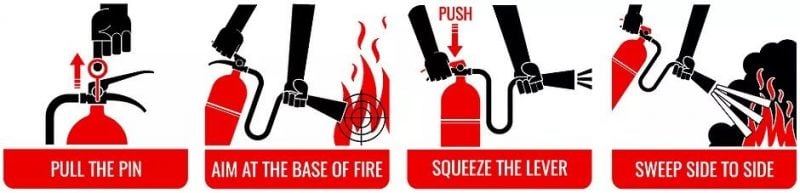
Like all other fire extinguishers, you need to remember the PASS-word. Pull the Pin Aim at the base of the fire. Squeeze the handle. Sweep from side to side.